

Flexible Sizing
A volume can be far larger than its cache, which holds only what is in use and warms on demand. Pay object storage prices for capacity and use NVMe for the hot set.
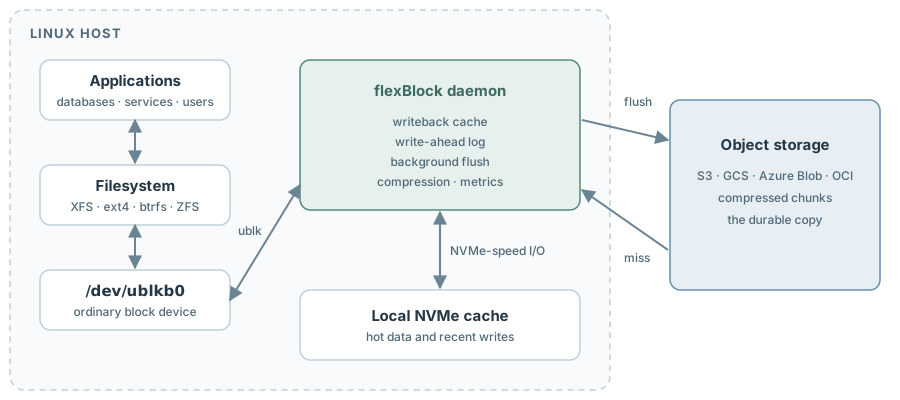
FlexBlock™ presents a bucket of object storage as a high-performance Linux block device, served through a local NVMe write-back cache. To your servers it is an ordinary disk (/dev/ublkbN) that you can format with XFS or ext4, mount, grow, move between hosts, or export over the network. To your storage bill it is a bucket of compressed objects plus a fast local SSD used only as a cache.
Flexible Sizing
A volume can be far larger than its cache, which holds only what is in use and warms on demand. Pay object storage prices for capacity and use NVMe for the hot set.
Durability for Ephemeral NVMe
Instance-local NVMe vanishes when the instance stops. As a flexBlock cache it risks only writes not yet flushed, though what remains in the bucket may need a filesystem check.
Host Portability
Detach a volume from one host and attach it to another with different hardware. An ownership marker and write lease keep two hosts from writing the same volume.
Crash-Safe Write-Back
Writes are acknowledged from NVMe and streamed to the bucket in the background. A daemon crash recovers with the filesystem still mounted.
Block Compression
Chunks can be compressed before upload with zstd (the default), lz4 or snappy, reducing both storage and transfer.
Total Visibility
A Prometheus endpoint reports cache, write-back lag, object storage and license health.
Four Cloud Backends
Amazon S3 (and S3-compatible stores with conditional writes), Google Cloud Storage, Azure Blob Storage and Oracle Cloud Infrastructure (OCI) Object Storage.
Any Filesystem
XFS, ext4, btrfs, OpenZFS, LUKS, LVM and mdadm work on the device as on any disk. The device can be exported over NVMe-oF/TCP, and a filesystem on it can be shared over NFS or SMB.